RSS

Thinking of Downsizing - Part III

Selling in 2027: Why Downsizers in the North Okanagan Benefit From Thinking Ahead

If your goal is to sell in 2027, you’re already ahead of the curve just by thinking about it now.

The smoothest, least stressful sales are rarely rushed. They’re planned.

Market cycles matter — especially locally

The Vernon and North Okanagan market shifts with interest rates, inventory levels, and buyer demand. Planning ahead allows you to:

  • Watch trends instead of reacting to them
  • Adjust timing if conditions change
  • Avoid selling under pressure

When you’re informed early, you get to choose when to act — not feel forced.

Equity planning is central for downsizers

For many homeowners, the family home represents decades of equity. Early planning helps you:

  • Estimate realistic net proceeds
  • Compare buying vs renting
  • Decide whether to sell first or buy first

Clarity reduces anxiety and makes the next step feel achievable.

Storage and lifestyle planning belong here too

Many people don’t think about storage until after they’ve sold — and that’s often when regret sets in.

Ask yourself now:

  • Will my future home fit the lifestyle I want to keep?
  • Do I want easy access to my gear, or am I okay with downsizing hobbies?
  • Would a storage unit add ongoing cost and inconvenience?

These questions shape better decisions — long before you list.

Think about future you

Health, energy, and mobility change. Planning early lets you:

  • Move once instead of multiple times
  • Choose a home that works long-term
  • Reduce physical and emotional stress
Read

Thinking of Downsizing in 2026 - Part II

Downsizing in 2026: How to Prepare Your Home Without Overdoing It

If 2026 is your target year to downsize, preparation is your biggest advantage. What you do before you list often has a greater impact on your outcome than what you do once the sign goes up.

The biggest mistake downsizers make? Waiting too long to prepare — then feeling rushed.

Declutter early, but with intention

Start where buyers won’t see — and where stress quietly builds:

  • Garages
  • Storage rooms
  • Spare bedrooms
  • Filing cabinets and paperwork

This isn’t about purging everything. It’s about identifying what truly needs to come with you — especially items tied to your lifestyle.

Decide what’s worth keeping close

This is the moment to separate:

  • Daily-use items
  • Seasonal gear you actively enjoy
  • “Just in case” items that haven’t been used in years

If you ski every winter, bike weekly, or paddle all summer, you’ll want a future home that accommodates that without friction. If you travel all winter, your storage needs will look very different.

Downsizing works best when your next home supports your life — not when it forces constant compromises.

Focus on updates that buyers actually value

You don’t need a full renovation. In Vernon’s established neighbourhoods, buyers respond best to:

  • Fresh, neutral paint
  • Updated or well-maintained flooring
  • Good lighting
  • Minor repairs completed

Homes that feel clean, bright, and well cared for consistently outperform those that feel dated or deferred.

Get a planning conversation early

A no-pressure review 12–18 months out helps you:

  • Decide what updates are worth doing
  • Avoid unnecessary spending
  • Time your sale more confidently

Preparation creates options — and options create leverage.

Read

Thinking of Downsizing in 2026 - Part I

Downsizing in 2026: Start With the “Why” — and the Lifestyle You Actually Live

If you’re considering downsizing in 2026, the most important work doesn’t start with listings, floor plans, or even price ranges. It starts with understanding why you want to downsize — and how you actually live day to day in the Vernon and the North Okanagan area.

Downsizing done well isn’t about giving things up. It’s about right-sizing your home to fit your next chapter.

Clarify the real motivation behind your move

Local downsizers often share similar goals, but they don’t all need the same type of home. Ask yourself:

  • Are you looking for less maintenance and yard work?
  • Do stairs feel less appealing than they once did?
  • Are you traveling more and want a “lock-and-leave” lifestyle?
  • Are you freeing up equity for retirement or family?

Your answers shape every decision that follows — especially what type of home will work best.

Lifestyle matters more than square footage

Many people focus on “smaller,” but the real shift is toward simpler living. In the Okanagan, that often means prioritizing:

  • One-level or main-floor living
  • Fewer exterior responsibilities
  • Proximity to shopping, medical services, and recreation
  • Quiet communities with strong resale demand

A 1,400 sq ft home that’s well designed can feel far more livable than a poorly laid-out 2,000 sq ft house.

Storage: the piece most downsizers underestimate

This is where many downsizing plans quietly fall apart.

Before choosing your next home, take an honest look at what you actually use and enjoy:

  • Are you a pickleball player who travels south all winter?
  • Do you ski SilverStar or Sovereign Lake, bike year-round, paddle or kayak Okanagan or Kal Lake?
  • Do you own multiple bikes, skis, or seasonal gear?
  • Do you have a boat, side-by-side or travel trailer?

Many downsizers quickly realize that off-site storage units are inconvenient, costly, and frustrating over time. Repeated trips across town to grab gear often take the joy out of the lifestyle they were trying to preserve.

In this market, smart downsizers look for:

  • Oversized garages
  • Secure storage lockers
  • Ground-level storage rooms
  • Space that keeps their lifestyle close by, not locked away

Give yourself emotional breathing room

Downsizing is both practical and emotional. Starting early in 2026 gives you time to:

  • Let go gradually
  • Talk through concerns
  • Avoid rushed decisions

The goal isn’t to move fast — it’s to move well.

Read

The True Cost of Home Ownership


The True Cost of Homeownership: What You Pay Beyond the Mortgage

When many new Canadian homebuyers calculate whether they can afford a new home, they focus almost exclusively on one number: the monthly mortgage payment. It’s the figure lenders use for the mortgage stress test, the number real estate agents discuss during showings, and the benchmark buyers use to determine their budget.[ratehub]​

However, the mortgage is only the starting line. Homeowners also pay for property taxes, insurance, utilities, strata special levies, surprise repairs, and ongoing maintenance. According to housing cost breakdowns from Ratehub, these non-mortgage expenses can easily add $1,500 or more per month on top of the mortgage, depending on the home and location. When you factor in these costs, a $3,000 monthly mortgage can quickly push total housing expenses well beyond $4,500 per month.[ratehub]​

So while qualifying for a mortgage answers one question, “Can a bank trust you with this loan?”, it doesn’t answer the more important one: “Can you comfortably maintain this lifestyle?”

In today’s market, about one in four Canadian homebuyers report experiencing at least some post-purchase regret. While most homeowners remain satisfied, research shows that regret often emerges when the true cost of ownership—such as maintenance, repairs, and ongoing living expenses—was higher than expected. To reduce the risk of buyer’s remorse, it’s critical for homebuyers to plan not just for the mortgage payment, but for the full cost of living in the home.ratehub+1

The Predictable Ongoing Costs

Property Taxes
Property tax bills have been rising in many Canadian cities as municipalities work to fund infrastructure and services. In 2024, the median year-over-year change in property tax rates among 24 major Canadian cities was about 4.9 percent, with some regions experiencing even greater increases.[zoocasa]​

Property taxes aren’t fixed. Reassessments and rate changes happen regularly, and as neighbourhood values rise, so do tax bills even when the rate stays the same.[zoocasa]​

Home Insurance
As of 2026, home insurance premiums in Canada have entered a “new normal.” Record weather-related losses in recent years, combined with higher rebuilding and replacement costs, continue to push insurers to raise rates and reassess risk across many regions.[ca.investing]​

In some provinces, home insurance premiums have increased sharply over the past decade, with upward pressure emerging nationwide. As insurers recalibrate risk at the postal-code level, homeowners can see their premiums rise $100–$200 per month in a single year—even without making a claim or changing coverage.[ca.investing]​

Condo and Strata Fees
For buyers entering the condo market, monthly fees typically range from $0.60 to $1.00 per square foot, depending on the building and amenities. These fees are mandatory and are used to fund day-to-day operations as well as long-term reserve funds for major repairs.[ratehub]​

By contributing regularly, owners help reduce the risk of large, unexpected special assessments later on.[ratehub]​

Utilities
Homeowners should budget between $250 to $600 monthly for utilities including electricity, heating, water, internet, and phone services, with costs varying based on your home’s size and location. These expenses often come as a surprise to first-time buyers, particularly those transitioning from apartment living where some utilities may have been included in rent. Larger homes naturally require more energy for heating and cooling, while properties with outdoor spaces may see higher water usage during warmer months.[ratehub]​

The "Commuter Tax"
There’s also what might be called “the commuter tax.” Moving to suburban markets for a cheaper house can increase gas and transit costs that often negate the mortgage savings. That apparent price difference can disappear quickly if you’re spending hundreds of dollars more each month on commuting.

Routine Maintenance
Beyond emergencies, Canadian homes require ongoing care: lawn service, gutter cleaning, pest control, HVAC servicing, snow removal, and seasonal tasks. These aren’t luxuries for many households—they’re practical solutions to time constraints and property upkeep in Canada’s demanding climate. Collectively, these services can add $200–$400 monthly to ownership costs.[ratehub]​

The Irregular—but Inevitable—Expenses

Major System Replacements
This is where many Canadian homeowners get caught off guard. Maintenance and repairs aren’t a matter of if but when—and rising labour and material costs have made these repairs significantly more expensive in recent years.[ca.investing]​

According to Statistics Canada and industry cost reports, home repair and maintenance costs have increased materially since 2018, driven by construction inflation and labour shortages. As a result, homeowners are commonly advised to budget 1%–2% of their home’s value annually for maintenance and long-term repairs.ratehub+1

Major system replacements can add up quickly:

  • Roof replacement: $8,000–$15,000+

  • HVAC (furnace or heat pump): $5,000–$12,000

  • Water heater: $1,200–$2,500

  • Foundation repairs: $4,000–$15,000+

These aren’t hypothetical expenses—they’re inevitable over time, with uncertain timing and rising costs.

Use the inspection as a planning tool. A 15-year-old furnace or aging roof signals $8,000–$15,000 in likely expenses within the first few years. That’s not a deal-breaker—it’s a budget roadmap. Buyers who understand these timelines can plan strategically instead of scrambling when systems fail.

Canada’s climate makes this worse. The “freeze-thaw” cycle wears down roofs, driveways, and foundations faster than in many milder climates, shortening the effective lifespan of key components. A roof that might last 25 years in a gentler environment may need replacement years sooner in parts of Canada.

Newer isn’t maintenance-free. Newer builds offer a temporary reprieve, but systems still age, warranties expire, and eventually every home requires major capital improvements.

Emergency repairs happen at the worst times. An HVAC failure during a cold snap, a burst pipe in winter, or ice dam damage to the roof—these scenarios happen when it’s least convenient and most expensive. Without liquid reserves, a single emergency can derail finances entirely.

Ownership Costs That Creep Up Over Time

Here’s what surprises many first-time Canadian buyers: the so-called “fixed costs” of homeownership aren’t actually fixed.

While a locked-rate mortgage provides payment stability for your term (typically 5 years in Canada), the other components—taxes, insurance, and condo fees—can climb significantly year over year due to inflation, climate risk, and local policy changes. A mortgage payment that felt comfortable at closing can feel tight three years later, even without lifestyle changes.[zoocasa]​

The “2026 Renewal Wall” presents a significant challenge for Canadian homeowners. Approximately 60% of all outstanding mortgages in Canada are expected to renew in 2025 or 2026, with many owners facing substantial payment increases. Unexpected costs go beyond just maintenance and repairs. Many homeowners will experience sticker shock when their mortgage payments reset at higher rates upon renewal.collectorhq+1

The same gradual creep affects utilities, maintenance services, and every other aspect of homeownership.[ratehub]​

Planning Smarter: How Canadian Homeowners Can Stay Ahead

Create a Dedicated House Repair Fund
Separate from emergency savings, this fund exists solely for home maintenance and repairs. Treat it like a non-negotiable monthly bill—set up automatic transfers so it happens without thinking about it.

The old rule of saving 1% of your home’s value annually for repairs is proving insufficient for some homeowners, particularly those with older properties or homes experiencing extreme weather. Aim for 2% if possible. For a newer home with recent updates, less might suffice. For an older property or one with systems nearing end-of-life, you’ll likely need to plan for greater costs.[ratehub]​

Don’t Drain Your Savings at Closing
Cash reserves protect against surprises and prevent forced debt when repairs arise. If possible, keep a liquid emergency repair fund after closing rather than putting every available dollar into the down payment or immediate renovations. That breathing room matters more than most buyers realize.[ratehub]​

Invest in Preventative Maintenance
Annual furnace servicing, gutter cleaning, and seasonal inspections catch small problems before they become expensive emergencies. A modest service call that prevents a major system failure is almost always worthwhile.

Create a seasonal maintenance calendar: HVAC checkups in spring and fall, gutter cleaning before winter, roof inspections after major storms. Consistency prevents costly surprises.

Leverage Canadian Tax Advantages
Consider leveraging Canadian tax advantages to build these reserves. First-time buyers should keep their FHSA (First Home Savings Account) open after purchase, or use the tax refund generated by it to seed their repair fund. The tax benefits you received while saving for the down payment can continue working for you as a homeowner.[ratehub]​

Know Your Home’s Systems and Timelines
Understanding when major systems were last replaced helps predict future expenses. A 15-year-old water heater isn’t an emergency today, but it signals a likely expense within the first few years of ownership. Planning beats scrambling.

Why Homeownership Still Makes Sense

Long-Term Equity Building
Mortgage payments build equity with every payment. Unlike rent, ownership creates a forced savings mechanism that compounds over decades. In most markets, homes appreciate over time, multiplying the wealth-building effect.[ratehub]​

Stability and Control
Homeowners control their living environment. Want to renovate the kitchen, paint the walls, landscape the yard, or install solar panels? Ownership provides autonomy that renting does not. That control has both lifestyle and financial value.[ratehub]​

Predictability vs. Rent Volatility
While ownership costs rise gradually over time, rent increases can be sudden and dramatic. A fixed-rate mortgage provides a level of predictability that the rental market cannot match.ratehub+1

Yes, taxes and insurance increase, but the principal and interest portion—typically a majority of the total payment—remains locked for your term. Renters face volatility on 100% of their housing costs.ratehub+1

Lifestyle Benefits
Beyond finances, homeownership offers intangible benefits: deeper community roots, stability for families, space for hobbies, and the pride of building something that’s truly yours. These benefits have real value, even if they don’t appear on a balance sheet.

The key is ensuring the financial foundation supports the lifestyle, not undermines it.

A Better Way to Think About Affordability

The true measure of affordability isn’t what a lender will approve—it’s what allows you to sleep well at night when the furnace fails or your mortgage comes up for renewal.

The smartest buyers calculate affordability as “mortgage plus carrying costs” from the start. This might narrow the price range slightly, but it creates breathing room and peace of mind that makes a house feel like a home.[ratehub]​

Homeownership remains one of the most powerful wealth-building tools available to Canadian families, but only when approached with financial realism rather than maximum leverage. Having an honest conversation about what affordability truly looks like isn’t about limiting dreams—it’s about making sure those dreams don’t become financial nightmares.[ratehub]​

Read

2025 Year in Review


North Okanagan Real Estate Wrap-Up: 2025 Ends on a Positive Note

After a fairly strong start early in the year, the North Okanagan real estate market faced a few bumps before regaining some momentum to close 2025 on solid footing. Activity early on reflected confidence, but external factors — including market uncertainty tied to U.S. policies under President Trump and the impact of tariffs — briefly slowed things down through spring. By mid-year, however, the market regained some positive momentum, finishing in a balanced position with sales improving across the board.


Early Momentum

The year began with notable strength. In January, sales soared 34% year over year, though they remained about 10% below the 10-year average. February continued the upward trend, up 20% over the previous year and tracking just 7% below the 10-year-average. Both months reflected absorption rates straddling between a buyer’s and balanced market.


A Spring Slowdown

March maintained solid year-over-year gains (+33%) but lost considerable footing versus long term sales figures coming in 28% under the 10-year average. By April, growth stalled, with no change over the previous year and continued weakness compared to longer-term trends. May marked possibly the lowest point of the year, with sales down 12% year over year and 21% below the 10-year-average; although the market did move back into balanced market territory.


Steady Recovery Through Summer

The turnaround began in June, as confidence crept back into the market. Sales grew modestly by 4% compared to 2024 and closed 16.5% under the 10-year average — a marked improvement from spring’s gaps. July and August kept the momentum going with year-over-year increases of 12% and 21% respectively.


A Mixed Bag Finish

The fall months brought even stronger performance. September led the pack with a 51% year-over-year surge, bringing sales within 3.7% of the 10-year average. Things then cooled off for a couple months with October seeing an 18% bump year-over-year and 13% off the 10 year average, while November saw -10% and -20% respectively.  December wrapped the year on a bright note with sales up 20% over 2024 and right on par with the 10-year-average average.


Bank of Canada


The Bank of Canada’s overnight rate started the year at 3.25% with 0.25% drops in January and again in March bringing the BoC rate down to 2.75% where it stayed until September.  Rates came down 0.25% in Sept and again in October bringing the BoC rate down to 2.25% where it finished off the year


The Takeaway

Despite spring headwinds, the North Okanagan market demonstrated resilience.  Sales numbers versus the 10-year-average made fairly steady gains after March lows (-28%) and ended the year with sales equaling the 10-year-average in December (a first since March 2022). 

Buyers benefited from interest rate relief and growing inventory through the year, while sellers saw balanced market conditions nine out of 12 months and renewed optimism as sales strengthened through the second half of the year (for the most part). 

It may have been a bit of a finicky market for sellers, but with the right pricing strategy homes sold (and often sold quickly).

Compared to many markets around the province - especially Greater Vancouver and the Fraser Valley - the North Okanagan faired quite well.

With slowly growing demand, good inventory levels, and with interest rates predicted to remain steady through 2026 the North Okanagan real estate market looks poised to continue to slowly gain strength.  While not a hot real estate year by any means 2025 did show continued growth and ended with stronger sales numbers than 2024 and 2023. 

Read

December Market Snapshot

December Closes the Year Strong in the North Okanagan

Items of Note for December

  •  North Okanagan Year-over-Year sales up 20%.  
  • Sales finally equal the 10 Year Average.  This is the first time since April 2022 that unit sales were not below the 10 Year Average.
  • North Okanagan continues to be in a Balanced Market 
  • Central Okanagan sales down 4% Year-over-Year and 13% below the 10 Year Average
  • British Columbia residential home sales down 5.9% Year-over-Year.
  • Next Bank of Canada rate announcement Wednesday January 28.
 

Sales

North Okanagan Unit Sales were up 20% Year-over-Year (98 vs 82) which equals the 10 Year Average of 98.  After being close to beating the 10 Year Average in September sales slowed down in Oct and Nov but December ended the year on a strong note.  Not only was it the first time since April 2022 that sales didn't come in below the 10 Year Average but it was also the strongest December in four years. 


Median Sales Price

  • Median Selling Price was $638,000, which was down 9% Year-over-Year ($702,000), and also down from Nov ($646,700). 


Average Sales Price
  • Average Selling Price was $770,635, which is up 7% Year-over-Year ($719,209), and also up from Nov ($679,689).


Benchmark Price

  • Single Family Home Benchmark price is $753,900, which is unchanged Year-Over-Year and up from November ($739,400)
  • Townhome Benchmark price is $556,500, which up 6% Year-over-Year but unchanged from November ($557,600).
  • Condo Benchmark price is $302,700, which is down 1% Year-over-Year and down from November ($309,800). 
  • The Overall Composite Benchmark Price for the North Okanagan was up almost 2% Year-over-Year ($653,500 vs $641,400) and up from November ($644,800).


Composite Benchmark Selling Price for the North Okanagan since March 2020. 


New Listings hitting the market were up 13% Year-over-Year (114 vs 101) which is about 21% above the 10-Year average (94).  

Active Listings are up 12% Year-over-Year (710 vs 634), which puts the North Okanagan about 20% above the 10 year average (594) for the month of December.


The overall North Okanagan market continues to be in a balanced market.

The Sales to Active Listings ratio is 14% (up from 13% in November). 
Between 12-25% is considered a Balanced Market.

The Sales to New Listing ratio is 86% (up from 63% in November). 
Between 40-60% is considered a Balanced Market but ratios skew higher in the winter months when the number of new listings hitting the market are low.  

Days to Sell Average is 81 days.  This is down Year-over-Year (99) and unchanged from November (81).


Central Okanagan


Unit Sales in the Central Okanagan for December were down 4% Year-over-Year (240 vs 250), which is 13% below the 10 Year Average of 277.  If you recall, November sales came in 25% below the 10 Year Average. 
 

Benchmark Price 

  • Single Family homes price $1,045,700 which is basically unchanged Year-over-Year and up from November ($1,021,000)
  • Townhome price $675,700 which is down 9.5% Year-over-Year and down from November ($752,800)
  • Condo price is $470,600 which is unchanged Year-over-Year but down from November ($486,700)
  • The Overall Composite Benchmark Price for the Central Okanagan was down Year-over-Year ($773,300 vs $784,100) and down from November ($787,700)
The chart below shows the Composite Benchmark Price for the Central Okanagan since March 2020.


December saw 365 New Listings hit the market, which is up 9% Year-over-Year (334) and 13% above the 10-Year Average of 324.

And the 2358 current Active Listings is up 2% Year-over-Year (2309) and is 42% above the 10-year average of 1665.

With a Sales to Active Listings ratio of 10% and Sales to New Listings ratio of 66% the Central Okanagan continues to be in a Buyer's Market.  

 For the full report click here
Read

November Market Snapshot

The Market Slows Down for the Holidays Early in the North Okanagan

Items of Note for November

  •  North Okanagan Year-over-Year sales down 10%.  Since November 2023 there have only been two months that experienced Year-over-Year sales declines (May being the other one).
  • Sales take a another step back against the 10 Year Average.  November sales in the North Okanagan come in 20% below the 10 Year Average - this is after September sales figures came in just 3.7% below the 10 Year Average. 
  • Central Okanagan sales down 8% Year-over-Year and 25% below the 10 Year Average
  • British Columbia residential home sales down 13% Year-over-Year.
  • Bank of Canada holds overnight rate at 2.25% .
 

Sales

North Okanagan Unit Sales were down 10% Year-over-Year (106 vs 118) which is 20% below the 10 Year Average of 132. 


Median Sales Price

  • Median Selling Price was $646,700, which was up 2% Year-over-Year ($631,25000), and up from Oct ($624,500). 


Average Sales Price
  • Average Selling Price was $679,689, which is unchanged Year-over-Year ($676,520), but down from Oct ($709,393).


Benchmark Price

  • Single Family Home Benchmark price is $739,400, which is down 3% Year-Over-Year and also down from October ($773,400)
  • Townhome Benchmark price is $557,600, which down 7% Year-over-Year and down from October ($570,300).
  • Condo Benchmark price is $309,800, which is up 1% Year-over-Year and but down from October ($314,800). 
  • The Overall Composite Benchmark Price for the North Okanagan was down Year-over-Year ($644,800 vs $664,700) and unchanged from October ($646,200).


Composite Benchmark Selling Price for the North Okanagan since March 2020. 


New Listings hitting the market were up 6% Year-over-Year (169 vs 160) which is about 4% above the 10-Year average (163).  

Active Listings are up 10% Year-over-Year (833 vs 756), which puts the North Okanagan about 17% above the 10 year average (713) for the month of November.


The overall North Okanagan market continues to be in a balanced market.

The Sales to Active Listings ratio is 13% (down from 16% in Octoberr, 15% in Sept, Aug, July, June and May). 
Between 12-25% is considered a Balanced Market.

The Sales to New Listing ratio is 63% (down from 74% in October). 
Between 40-60% is considered a Balanced Market.  

Days to Sell Average is 81 days.  This is up Year-over-Year (76) and up from October (79).


For the full report click here

Read

Should You Sell in the Winter

Winter can be a surprisingly strategic time to sell your home in Vernon, BC and the North Okanagan, and knowing the insider advantages will give you the edge in the marketplace. Unlike the crowded spring and summer selling seasons, winter offers unique benefits that only the most knowledgeable homeowners take advantage of—making you the person everyone turns to for real estate wisdom in the Okanagan.


Reduced Competition, Serious Buyers

During winter in Vernon, there are fewer homes on the market. That means less competition for your property, making it stand out and catch the attention of motivated buyers. Many sellers wait for spring, but those who enter the winter market tap into a serious and focused pool of buyers—people who need to move for work, family, or other life changes and are not deterred by a little snow. This can lead to quicker sales and even multiple-offer scenarios if your home is priced right and presented well.​


Homes Sell Year-Round—At Great Prices

It’s a myth that homes don’t sell or fetch lower prices during the winter months. In reality, statistics and local trends show strong, steady activity throughout the year. Motivated winter buyers often make faster decisions and are less likely to use small cosmetic issues as bargaining chips. According to Canadian real estate data, homes sold in December through February can sell at prices comparable, and sometimes even superior, to peak seasons. This means you don’t have to sacrifice on value just because it’s cold outside.​


Leverage Cozy Winter Features

Winter also allows you to showcase the best cozy aspects of your home. Highlight fireplaces, efficient heating, and winter décor to create an inviting atmosphere. Tasteful holiday or winter decorations, freshly shoveled sidewalks, and a warm, well-lit interior will resonate with buyers picturing their own gatherings in the space. In this season, even small efforts in curb appeal—like keeping walks clear and adding evergreens—go a long way.​


Shorter Winters Can Mean Spring-like Closings

Okanagan’s winters are generally milder and shorter compared to other parts of Canada. Sellers can list in winter and, by the time offers are accepted and deals close, spring-like weather often arrives, making the process more seamless than expected. 


In fact, if you are just now considering selling this winter, by the time you are ready to get your home on market, get pictures, video and marketing materials ready and get an accepted offer there is a good time you will be heading into spring by the time you need to move.  


Okanagan Winter Attracts New Residents

The Okanagan offers a wide range of winter activities, from skiing and snowboarding at world-class resorts -  don’t forget Sovereign Lake for the skinny ski set - to exploring snowy snowshoe trails, fat tire biking, cold plunging in Kal Lake, wine tasting, and relaxing at spas. While the mountain areas receive abundant "champagne powder," the valley experiences milder temperatures, allowing for year-round hiking and other activities.  After falling in love with all the winter activities available in the Okanagan some of these visitors will likely turn into Okanagan residents.


Where Are You and What Are You Selling

If you’re selling a condo or a smaller townhome then moving in winter really isn’t that much of an inconvenience.  However, as your home increases in square footage and acreage you may want to reconsider selling a little closer to spring to make your move easier.  And the same goes for location.  In the valley the snow load can be quite low but head up towards Silver Star or further away from Vernon and you may run into snow loads that make you want to reconsider having to move until early spring.   These are all logistics that can be figured out between you as the seller and your trusted real estate professional Mark Nichiporuk


Maximize Your Digital Presence

Most buyers today begin their search online. Winter shoppers often spend more time at home browsing listings, so invest in professional photography and virtual tours. This boosts your property’s visibility and appeal—regardless of the weather. With fewer homes to compete with, your listing will naturally receive more attention and attract buyers who are ready to act.​


Pro Tips Only North Okanagan Insiders Know

Stay flexible with showings to accommodate buyers’ busy winter schedules.

Share evidence of your home’s energy efficiency—lower heating bills are a powerful selling point.

Partner with Mark Nichiporuk, your trusted Okanagan real estate professional, to price your home perfectly for winter buyers and market trends.​ 

Read

Mortgage Renewal Decisions — Should You Switch Lenders or Stay Put?

When your mortgage comes up for renewal, you face a key choice: stick with your current lender or shop around. Many homeowners automatically renew, but that can cost thousands over time.

Staying put is convenient. You avoid paperwork, appraisals, and the stress of negotiating. If your lender’s offer is competitive and you value simplicity, renewing directly might make sense, especially if your income or debt levels have changed and requalifying could be difficult.

Switching lenders can pay off if you are willing to do a little legwork. Competing lenders may offer lower rates, better prepayment options, or terms that fit your future plans. Even a small rate difference, such as 0.25%, can translate to significant savings over a five-year term.

Example: A homeowner with a $400,000 mortgage could save over $4,000 in interest just by switching to a lender offering a slightly lower rate.

Before signing that renewal letter, take time to review your goals. Are you planning to move, refinance, or pay off faster? A mortgage professional can compare offers and help you decide whether staying or switching aligns best with your financial picture.


Reprinted with permission of Dan Oliver at Oliver Mortgage

Read

October Market Snapshot

A Solid Month in the North Okanagan

Items of Note for October

  • Sales take a step back against the 10 Year Average.  October sales in the North Okanagan came in 13% below the 10 Year Average - this is after September sales figures came in just 3.7% below the 10 Year Average.  
  • North Okanagan Year-over-Year sales up 18%.
  • Central Okanagan sales down 4% Year-over-Year and 18% below the 10 Year Average
  • British Columbia residential home sales down 10.2% Year-over-Year and come in 17.1% below the 10 Year Average.
  • Bank of Canada lowers interest rate to 2.25%.  Next rate announcement December 10th.


Sales

North Okanagan Unit Sales were up 18% Year-over-Year (150 vs 127) which is 13% below the 10 Year Average of 172. 


Median Sales Price

  • Median Selling Price was $624,500, which was down 7% Year-over-Year ($672,000), and down from Sept ($632,000). 


Average Sales Price

  • Average Selling Price was $709,393 which is down 9% Year-over-Year ($780,252), but up from Sept ($690,329).


Benchmark Price

  • Single Family Home Benchmark price is $773,400, which is up 4% Year-Over-Year and also up from September ($753,500)
  • Townhome Benchmark price is $570,300, which down 2% Year-over-Year and down from September ($596,200).
  • Condo Benchmark price is $314,800, which is unchanged Year-over-Year and also unchanged from September ($315,900). 
  • The Overall Composite Benchmark Price for the North Okanagan was up Year-over-Year ($669,300 vs $651,000) and up from September ($663,100).


Composite Benchmark Selling Price for the North Okanagan since March 2020. 


New Listings hitting the market were up 4% Year-over-Year (201 vs 193) which is about 4% below the 10-Year average (209).  

Active Listings are up 5% Year-over-Year (945 vs 900), which puts the North Okanagan about 16% above the 10 year average (816) for the month of October.


The overall North Okanagan market continues to be in a balanced market.

The Sales to Active Listings ratio is 16% (Up from 15% in Sept, Aug, July, June and May). 
Between 12-25% is considered a Balanced Market.

The Sales to New Listing ratio is 74% (up from 55% in Sept). 
Between 40-60% is considered a Balanced Market.  

Days to Sell Average is 79 days.  This is down Year-over-Year (81) but up from Sept (76).

For the full report click here

Read

September Market Snapshot

Best Month Since April 2022?

Items of Note for September

  • Sales continue to improve against the 10 Year Average.  It looked like North Okanagan sales were finally going to end up above the 10 Year Average (it would have been the first time since April 2022).  In the end, we finished 7 sales shy (156 vs 162) and came in 3.7% below the 10 Year Average.  This is still our best monthly result vs the 10 Year Average since April 2022 so one could argue that this is the best monthly sales result since April 2022.  
    Rounding out the top 3 results are: June 2023 4.1% below and May 2022 6.1% below.   August sales were 11% below the 10 Year Average.  
  • North Okanagan Year-over-Year sales up 51%.
  • Central Okanagan sales up 40% Year-over-Year but still 15% below the 10 Year Average
  • British Columbia residential home sales up 4.4% Year-over-Year (the 4th month in a row with positive Year-over-Year sales growth) but is still 21.4% below the 10 Year Average.
  • Bank of Canada next interest rate announcement Wed Oct 29.
 

Sales

North Okanagan Unit Sales were up 51% Year-over-Year (156 vs 103) which is just 3.7% below the 10 Year Average of 162. 


Median Sales Price

  • Median Selling Price was $632,000, which was down almost 7% Year-over-Year ($677,000), and down slightly from Aug ($637,000). 


Average Sales Price
  • Average Selling Price was $690,329 which is down 11% Year-over-Year ($773,552), and down from Aug ($734,875).


To see full report click here

Read

August Market Snapshot

Continues to Show Signs of Improvement

Items of Note for August

  • North Okanagan Year-over-Year sales up 21%.
  • Sales continue to improve against the 10 Year Average.  August sales were 11% below the 10 Year Average while July sales were 14% below the 10 Year Avg, June sales were 17% below, May sales were 21% below, April was 23% and March sales were 28% below the 10 Year Avg.  If you recall sales had climbed within 7% of the 10 Year Avg in Feb before the market slowed down with the threat/introduction of US tariffs etc.  The last time sales came in above the 10 Year Average was April 2022.
  • The North Okanagan continues to be in a Balanced market
  • Central Okanagan sales up 14% Year-over-Year but loses lots of ground vs the 10 Year Average
  • British Columbia residential home sales for month of August up 0.5% Year-over-Year - the 3rd month in a row with positive Year-over-Year sales growth
  • Bank of Canada lowered its key interest rate by 25 basis points to 2.5 per cent, marking its first cut since March
 

Sales

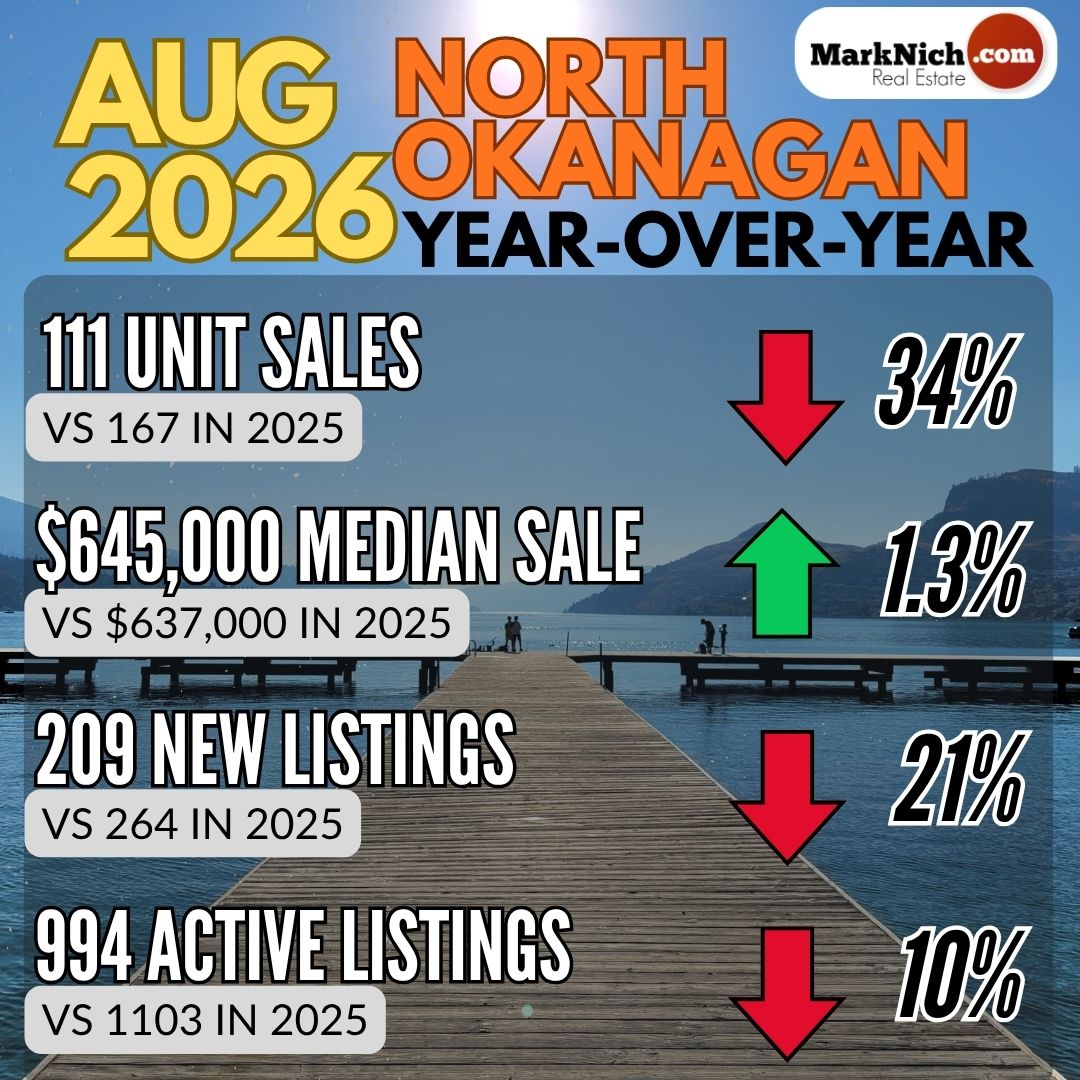
North Okanagan Unit Sales were up 21% Year-over-Year (167 vs 138) which is just 11% below the 10 Year Average of 188. 

August's 167 home sales surpasses 2022 (141), 2023 (146) and 2024 (138).


Median Sales Price

  • Median Selling Price was $637,000, which was down 1% Year-over-Year ($644,500), but up slightly from July ($635,000). 


Average Sales Price
  • Average Selling Price was $734,875 which is down 2% Year-over-Year ($748,629), but up from July ($703,172).

For full report click here

Read
The trademarks REALTOR®, REALTORS®, and the REALTOR® logo are controlled by The Canadian Real Estate Association (CREA) and identify real estate professionals who are member’s of CREA. The trademarks MLS®, Multiple Listing Service® and the associated logos are owned by CREA and identify the quality of services provided by real estate professionals who are members of CREA. Used under license.